
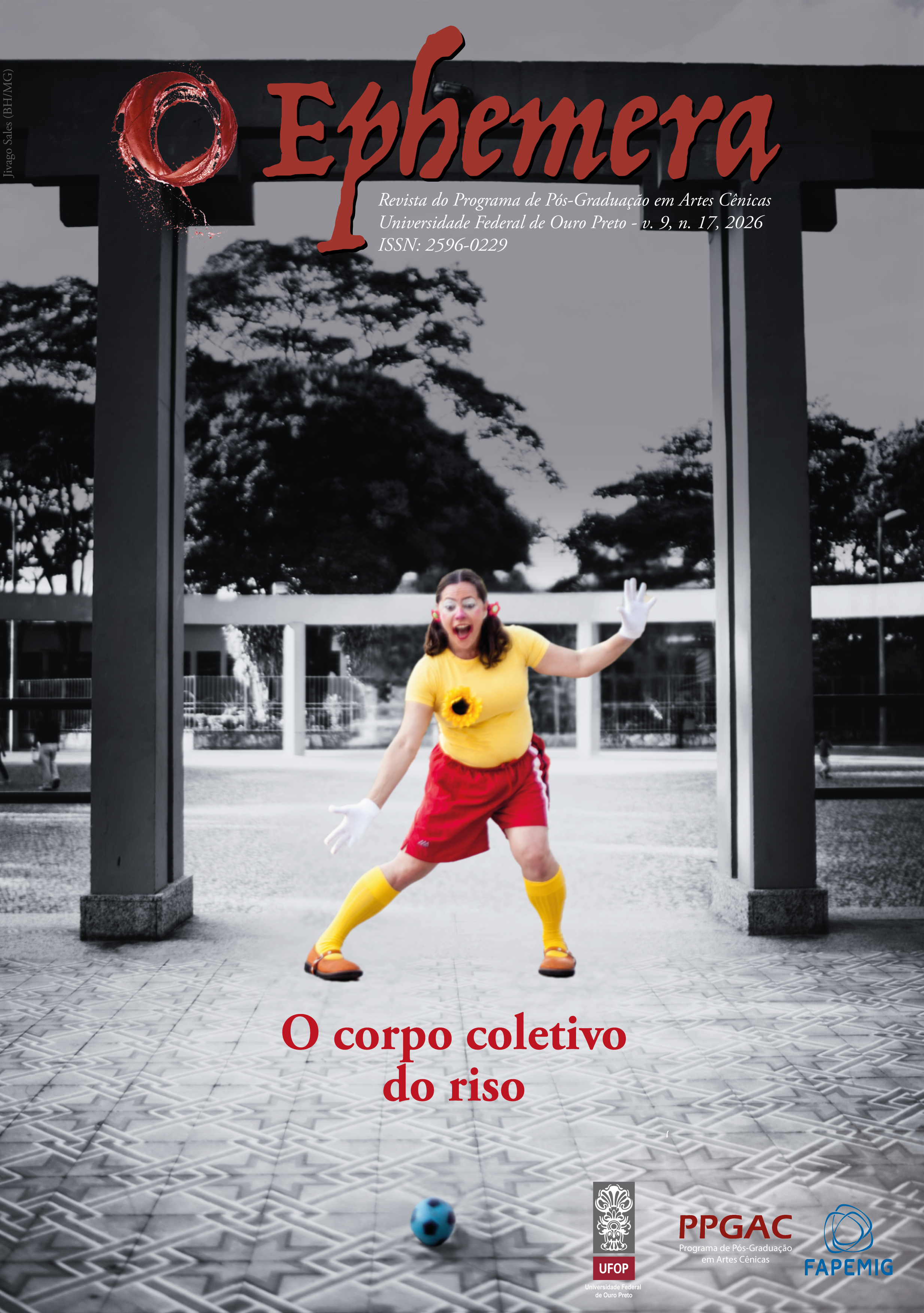
Memoirs of a clown who dared to laugh
DOI:
10.70446/ephemera.v9i17.8438Palavras-chave:
clown, clowning, female clowning, intersectionality, motherhood in arts, gender violencResumo
This autobiographical article examines the journey of a clown–mother–researcher, addressing intersectional challenges in Brazilian female clowning. Through three key episodes—harassment during performance (2006), misogynistic audience aggression (2024), and comparisons in mixed-gender duos (2025)— it reveals how the female comic body negotiates gender stereotypes, motherhood, and structural violence. Diving into feminist theories (hooks, Iaconelli, Crenshaw) and femicide data (FBSP, 2023), the study demonstrates that clowning, traditionally a male-dominated field, imposes on women a double burden: artistic excellence and social policing. The narrative exposes issues ranging from onstage objectification to the isolation of artistic motherhood and the academic invisibility of researcher–mothers. It frames laughter as political resistance, proposing a feminist reinterpretation of the grotesque as a tool to destabilize patriarchy. The analysis particularly highlights the paradox of the red nose—symbol of freedom yet insufficient protection against gender violence; the “spectral masculinity” of absent fathers in maternal narratives; and the embodied cost of triple shifts (artist-researcher-mother). Ultimately, it celebrates clowning as a language of insurgency that exposes gender asymmetries persisting even beneath the comic disguise.
Downloads
Referências
ANUÁRIO BRASILEIRO DE SEGURANÇA PÚBLICA 2023. São Paulo: Fórum Brasileiro de Segurança Pública, ano 17, 2023. Disponível em: https://publicacoes.forumseguranca.org.br/items/6b3e3a1b-3bd2-40f7-b280-7419c8eb3b39 . Acesso em: 05 jan. 2026. BERGSON, H. O Riso: Ensaio sobre a Significação do Cômico. Tradução de Ivone Castilho Benedetti. São Paulo: Martins Fontes, 2001. CRENSHAW, K. Demarginalizing the intersection of race and sex. A Black Feminist Critique of Antidiscrimination Doctrine, Feminist Theory and Antiracist Politics. University of Chicago Legal Forum, n. 1, v. 1989, 1989. Disponível em: https://chicagounbound.uchicago.edu/uclf/vol1989/iss1/ . Acesso em: 05 jan. 2026. DAVIS, A. Mulheres, raça e classe. Tradução de Heci Regina Candiani. 1. ed. São Paulo: Boitempo, 2016. FUCHS, Ana Carolina Müller. O Sorriso da Palhaça: Pedagogias do Riso e do Risível. 2022. Tese (Doutorado em Educação) – Programa de Pós-Graduação em Educação, Faculdade de Educação, Universidade Federal do Rio Grande do Sul, Porto Alegre, 2022. hooks, b. O feminismo é para todo mundo: políticas ardorosas. Tradução de Bhuvi Libanio. Rio de Janeiro: Rosa dos Tempos, 2018. IACONELLI, V. O Manifesto Antimaternalista. Rio de Janeiro: Zahar, 2023 INSTITUTO PATRÍCIA GALVÃO. Violência no Ambiente Cultural. São Paulo: Instituto Patrícia Galvão, 2023. OBSERVATÓRIO DA VIOLÊNCIA CONTRA A MULHER. Relatório 2022. Rio de Janeiro: Observatório da Violência contra a mulher, 2022. OLENDZKI, L. C. A dupla cômica de palhaços: parceria de jogo, operação de funções e princípios da arte clownesca. Revista Arte da Cena, Goiânia, v. 2, n. 3, p. 33-52, jul./dez. 2016. Disponível em: https://revistas.ufg.br/artce/article/view/43899/22492 . Acesso em: 05 jan. 2026. VIVEIROS DE CASTRO, A. O Elogio da Bobagem: palhaçaria feminina como atitude filosófica. Rio de Janeiro: Cobogó, 2017.
Downloads
Publicado
Edição
Seção
Licença
O/As autore/as mantêm os direitos autorais sobre os documentos publicados pelo periódico e cedem ao periódico o direito de publicação dos textos e de seus metadados (em múltiplos suportes e formatos), inclusão em bases de dados e assinatura de acordos de indexação atuais e futuros (mesmo com licenças menos restritivas, para os textos, ou sem restrições, para os metadados), de modo a garantir a indexação do documento publicado e de seus metadados.
O documento publicado será distribuído nos termos da Licença Creative Commons Atribuição - Não-Comercial 4.0 Internacional (CC-BY-NC) que permite o uso, a distribuição e reprodução em qualquer meio desde que sem fins comerciais e que o artigo, os autores e o periódico sejam devidamente citados.